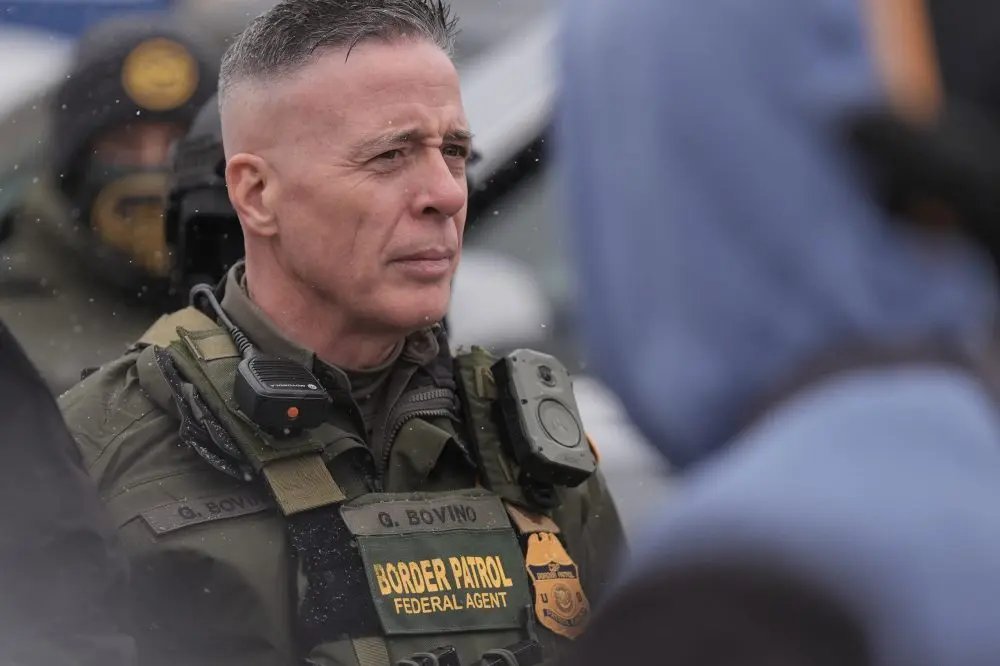
The commander of President Donald Trump’s immigration crackdown in Minneapolis is leaving the city after federal agents fatally shot two people in less than three weeks.
Gregory Bovino had been the go-to architect for the large-scale immigration crackdowns ordered by Trump and the public face of his administration’s city-by-city sweeps. The Border Patrol chief led agents in Los Angeles, Chicago and New Orleans before he headed to Minnesota in December for what the Department of Homeland Security called its largest-ever immigration enforcement operation.
He’s also been heavily criticized for his norm-breaking tactics.
Here’s what to know about Bovino’s career, methods and approach:
Bovino revels in breaking norms. Agents have smashed car windows, blown open a door to a house and patrolled the fabled MacArthur Park in Los Angeles on horseback.
Smashing windows when a driver refuses to open and is subject to arrest is “a safer tactic than letting someone drive away and then getting in a high-speed pursuit,” he said.
Blasting the door off a home in Huntington Park, California, to search for a man accused of ramming a Border Patrol vehicle days earlier was a “very, very prudent, thoughtful application of tactics,” said Bovino, who joined that early-morning raid. “I don’t want to surround a house for hours and hours and hours and then create another riot.”
Bovino often appears in tactical gear, as he did outside California Gov. Gavin Newsom’s news conference on congressional redistricting in August.
In Chicago, agents stormed an apartment complex by helicopter, deploying chemical agents near a public school and handcuffed a Chicago City Council member at a hospital.
Agents rappelled down to the apartment building from a Black Hawk helicopter. Authorities said they were targeting the Venezuelan gang Tren de Aragua, but only two of the 37 immigrants arrested were gang members. The others were in the country illegally, they said, including some with criminal histories. One U.S. citizen was arrested on an outstanding narcotics warrant.
Activists, residents and leaders said the combative tactics sparked violence and fueled neighborhood tensions in the nation’s third-largest city.
Bovino also drew a rare public rebuke from a federal judge who said he misled the court about the threats posed by protesters and deployed tear gas and pepper balls without justification during a chaotic confrontation downtown.
U.S. Immigration and Customs Enforcement, the agency primarily responsible for interior immigration enforcement since its was created in 2003, has historically made arrests in the streets after lengthy investigations of individual targets, including surveillance that an official once likened to watching paint dry. Officials rarely have judicial warrants to enter a home, causing them to wait outside.
It is not a pace that will lead to the mass deportations Trump has promised.
“We’re going to turn and burn to that next target and the next and the next and the next, and we’re not going to stop,” he said in an interview in a seventh-floor conference room of the federal building in West Los Angeles, where an unused office wing serves as a sparsely furnished temporary base.
Bovino was one of 20 regional Border Patrol chiefs around the country when he was relieved of his command leading leading the agency’s sector in El Centro, California.
He blamed an online profile picture of him posing with an M4 assault rifle; social media posts that were considered inappropriate; and sworn congressional testimony that he and other sector chiefs gave on the state of the border during a record surge of migrants.
Thirty minutes after his second congressional hearing, Bovino said, he was removed from his position and asked, “Are you going to retire now?”
He didn’t retire. The change in administration from President Joe Biden to Trump in 2025 turned Bovino into a MAGA-world hero. The profile photo with the assault rifle was back online and by the summer, he was leading immigration enforcement in Los Angeles, where the Trump administration launched its first sustained blitz of a U.S. city.
Bovino joined the Border Patrol in 1996 and is nearing the agency’s mandatory retirement age of 57. He eventually plans to return home to North Carolina to harvest apples.
He served as Border Patrol chief in El Centro, California, long a relatively quiet part of the southern border that has become even quieter as illegal crossings have plummeted to their lowest levels in six decades.
His media savvy is on display each summer when Border Patrol sector chiefs hold news conferences to warn against illegal crossings. In 2021, Bovino led journalists in swimming across the All-American Canal, whose deceptively swift current and smooth concrete lining result in migrant deaths every year. In 2023, he locked reporters in a vehicle trunk, saying he wanted them to appreciate the dangers firsthand.
While administration officials like to say they are deporting the “worst of the worst,” Bovino embraces arrests of hard-working people with deep roots in the country. He said they “skip the line” ahead of people waiting to enter the country legally.
“The folks undercutting American businesses, is that right?” he said. “Absolutely not. That’s why we have immigration laws in the first place, and that’s why I’m here.”
ICE has led interior immigration enforcement since it was created in 2003, but the Border Patrol has been around much longer. Bovino’s sense of mission never strayed from the Border Patrol’s roots. When assigned to lead a station in Blythe, California, he pitched his boss, Paul Beeson, on raiding the airport and bus stations in Las Vegas.
The 2010 operation was supposed to last three days but got called off after the first hour yielded dozens of arrests and unleashed a furious reaction from then-Senate Majority Leader Harry Reid, a Nevada Democrat.
“He’s not afraid to push the envelope, very articulate, leads from the front,” said Beeson, who, as a sector chief, selected Bovino to lead stations in Blythe and in Imperial Beach, California.
Brought to you by www.srnnews.com