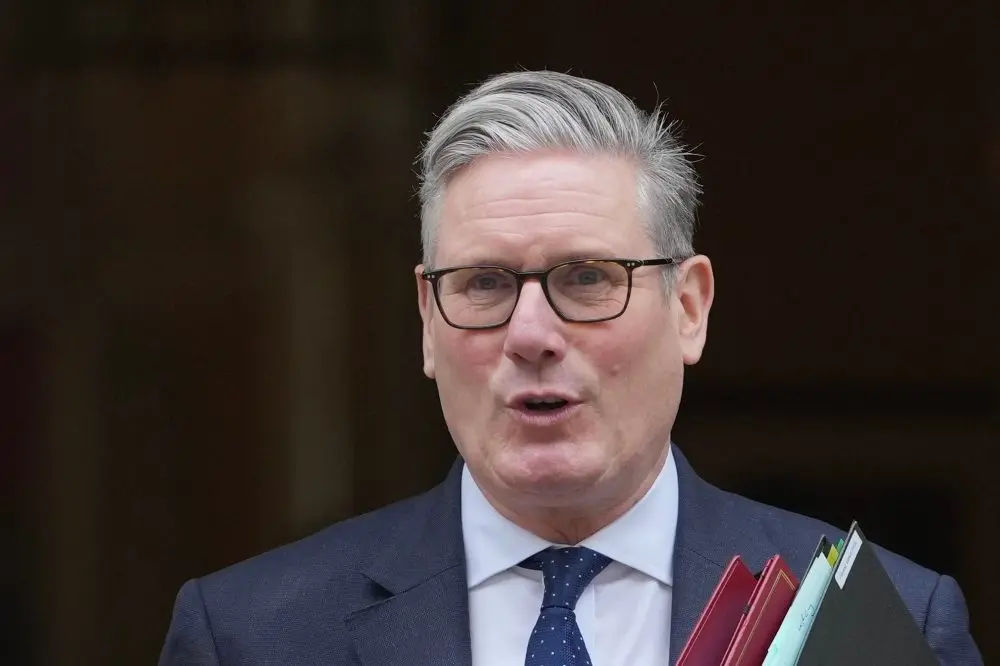
LONDON (AP) — Opposition politicians accused U.K. Prime Minister Keir Starmer on Wednesday of weakening Britain’s “special relationship” with the United States by differing from U.S. President Donald Trump over Iran and drawing his ire.
Trump on Tuesday called Britain “uncooperative” and slammed Starmer as “not Winston Churchill” after Starmer initially rebuffed a U.S. request to use U.K. bases for attacks on Iran. The prime minister later said American planes could use bases in England and on the Indian Ocean island of Diego Garcia to strike Iranian missile systems that are targeting British allies in the Middle East.
Trump remains annoyed, and Starmer is bracing to see whether the president’s anger has an impact on trans-Atlantic ties and trade.
Churchill set the tone for the post-World War II trans-Atlantic bond by declaring during a 1946 speech at Westminster College in Missouri that there was “a special relationship between the British Commonwealth and Empire and the United States.”
That relationship has been sustained over the decades by a common language, shared interests, military cooperation and cultural affection. Sometimes that has been bolstered by close personal bonds, such as the friendship between Prime Minister Margaret Thatcher and U.S. President Ronald Reagan in the 1980s, or between Tony Blair and Bill Clinton in the 1990s.
There have also been periods of strain. In 1956, Israel, Britain and France attempted to seize control of the Suez Canal after its nationalization by Egypt. Their forces eventually withdrew after U.S. President Dwight D. Eisenhower’s administration refused to back the effort and threatened sanctions. It was a stark reminder of Britain’s waning power and American ascendancy on the world stage.
A decade later, relations hit a new low when British Prime Minister Harold Wilson resisted pressure from U.S. President Lyndon B. Johnson to join the Vietnam War.
Blair was seeking to avoid a similar rift when he sent British troops to join the U.S.-led invasion of Iraq in 2003 based on what turned out to be faulty intelligence about Saddam Hussein’s alleged weapons of mass destruction. The conflict killed 179 British troops, around 4,500 American personnel and many thousands of Iraqis. Blair’s decision remains one of the most controversial by a British leader in decades.
Center-left leader Starmer has forged surprisingly cordial relations with Trump since the president’s return to office in 2025, but friction between the two leaders has been building for months. Trump’s threat to take over Greenland was denounced by Starmer and other European leaders earlier this year.
Recently, Trump has condemned Britain’s agreement to hand over the Chagos Islands, home to the Diego Garcia base, to Mauritius, despite his administration earlier backing the deal.
Starmer has strongly implied that he considers the war on Iran illegal and said his government doesn’t believe in “regime change from the skies.”
Cabinet minister James Murray said Starmer was acting with “a cool head,” and argued that Britain’s relationship with the U.S. remains “historic, long-lasting and deep.”
But political opponents and critics in the media claim that Starmer is sidelining the U.K. at a critical time, even after an Iranian-made drone struck a British air force base on Cyprus, causing no injuries. The right-leaning Daily Mail proclaimed: “Starmer takes the Great out of Britain.”
Conservative leader Kemi Badenoch said Wednesday in the House of Commons that Starmer should have declared support for the U.S.-Israeli offensive, and Conservative lawmaker Gareth Bacon accused the prime minister of a “dithering and equivocal response” to events.
Starmer replied that “American planes are operating out of British bases. That is the special relationship in action.
“British jets are shooting down drones and missiles to protect American lives in the Middle East on our joint bases. That is the special relationship in action. Sharing intelligence every day to keep our people safe. That is the special relationship in action.
“Hanging on to President Trump’s latest words is not the special relationship in action.”
The U.S. president’s moods can be fleeting, and British officials hope this latest squall will blow over quickly.
Trump’s threat this week to cut of trade with Spain after Prime Minister Pedro Sánchez condemned the strikes on Iran as “unjustifiable” and “dangerous” shows how high the stakes can be.
The U.K. deal with Mauritius over the Chagos Islands, which Britain says is crucial to securing the future of the Diego Garcia base, is on hold until U.S. backing is secured. A trade deal signed by Trump and Starmer with great fanfare in May still hasn’t been finalized, and has been cast into doubt by Trump’s recent tariff pronouncements.
Peter Ricketts, a former U.K. national security adviser, said that Trump appears to want “completely blind loyalty” from allies, and had launched an “unfair” broadside against Starmer. But he said that British authorities shouldn’t overreact.
“I think the prime minister should keep calm and carry on,” he told the BBC.
Brought to you by www.srnnews.com