WASHINGTON (AP) — Two hotly contested U.S. Senate primaries in Texas will help officially kick off the 2026 midterm election cycle Tuesday, when voters in three states will pick nominees to compete in the November general election.
Republicans hold a 53-47 majority in the Senate. Democrats face a tough path to retaking the chamber in 2026, but they hope the right combination of primary outcomes in Texas will help put the state in play in a midterm year when the president’s party typically loses seats in Congress.
Voters in the Lone Star State will also choose nominees for a full slate of state offices, from governor to state Legislature. Arkansas and North Carolina also hold primaries on Tuesday.
Republican incumbent Sen. John Cornyn cruised to renomination in his four previous U.S. Senate campaigns but this year has drawn a tough challenge from state Attorney General Ken Paxton, U.S. Rep. Wesley Hunt and five others. Only two incumbent U.S. senators from Texas have lost a primary in the last 100 years.
U.S. Rep. Jasmine Crockett and state Rep. James Talarico are in a competitive race for the Democratic nomination. A third Democratic contender, Ahmad Hassan, is a frequent candidate in both Texas and Minnesota.
In the race for governor, incumbent Greg Abbott faces 10 Republican challengers in his run for a fourth term. The Democratic field includes former U.S. Rep. Chris Bell, state Rep. Gina Hinojosa and six other active candidates.
Further down the ballot, U.S. House candidates compete in new congressional districts that state Republicans redrew at President Donald Trump’s urging as part of an effort to maintain control of the chamber.
There’s no guarantee the new map will have the effect its designers intended, but the impact on some Democrats is immediate. U.S. Reps. Christian Menefee and Al Green will face each other and two others in the redrawn 18th Congressional District. In the new 33rd Congressional District, Democratic U.S. Rep. Julie Johnson faces former U.S. Rep. Colin Allred and two others in the primary.
Vulnerable Republican incumbents include Reps. Dan Crenshaw and Tony Gonzales, who face strong primary challenges in the 2nd and 23rd congressional districts, respectively. Gonzales has faced calls to resign from fellow Republicans over allegations of an affair with a former staffer who killed herself.
Texas primary winners must receive a majority of the vote to avoid a May 26 runoff.
Texas Democrats typically face an uphill climb in the general election. Democrats have not won statewide office in Texas, from governor to railroad commissioner, since 1994. No Texas Democrat has won a U.S. Senate race since 1988. The last Democrat to hold Cornyn’s seat was Lyndon Johnson.
Harris County, home to Houston, is by far the state’s most populous and plays a major role in both Republican and Democratic primaries. Dallas and Travis counties, while still influential in Republican primaries, tend to contribute a larger share of the total vote in Democratic contests. Tarrant County, home to Fort Worth, tends to play a bigger role in Republican primaries.
In the Republican Senate primary, since much of the campaign has focused on Cornyn’s conservative bona fides in the Trump era, the counties where the president has the most support could play a decisive role. Although many of the counties Trump won in 2024 with 80% or more of the vote are rural and sparsely populated, collectively they made up about a fifth of the vote in past state GOP primaries. Both Cornyn and Paxton received overwhelming majorities in these top Trump counties in their last primaries, but Cornyn performed worse there than he did in the rest of the state, while Paxton performed better.
In the Democratic primary, key areas to watch include counties with large Hispanic populations along the border, especially El Paso and Hidalgo counties, and those with large African American populations, including those in East Texas, which are a part of a region across the South often called the Black Belt.
The Associated Press does not make projections and will declare a winner only when it’s determined there is no scenario that would allow a trailing candidate to close the gap. If a race has not been called, the AP will continue to cover any newsworthy developments, such as candidate concessions or declarations of victory. In doing so, the AP will make clear that it has not yet declared a winner and explain why.
Texas requires an automatic recount only in cases of a tie vote. Losing candidates may request and pay for a recount if the margin is less than 10% of the leading candidate’s vote. The AP may declare a winner in a race that is subject to a recount if it can determine the lead is too large for a recount or legal challenge to change the outcome.
Here are some of the key facts about the election and data points the AP Decision Team will monitor as the votes are tallied:
Polls close statewide at 7 p.m. local time, but the state is split into two times zones. Polls in most of Texas close at 8 p.m. ET, while polls in the westernmost part of the state close at 9 p.m. ET. Although a significant amount of vote results from most of the state will be released between 8 p.m. and 9 p.m. ET, the AP will not make any race calls in statewide contests until the last polls close at 9 p.m. ET.
The AP will provide vote results and declare winners in contested primaries for U.S. Senate, U.S. House, governor, lieutenant governor, attorney general, comptroller, land commissioner, agriculture commissioner, railroad commissioner, state Supreme Court and Court of Appeals, state Board of Education and both chambers of the state Legislature.
Any eligible voter may participate in any party’s primary. Voters in Texas do not register by party, but voting in a party’s primary affiliates a voter with that party, which is then used to determine eligibility to vote in the May runoff election.
As of the November 2025 general election, there were about 18.5 million registered voters in Texas.
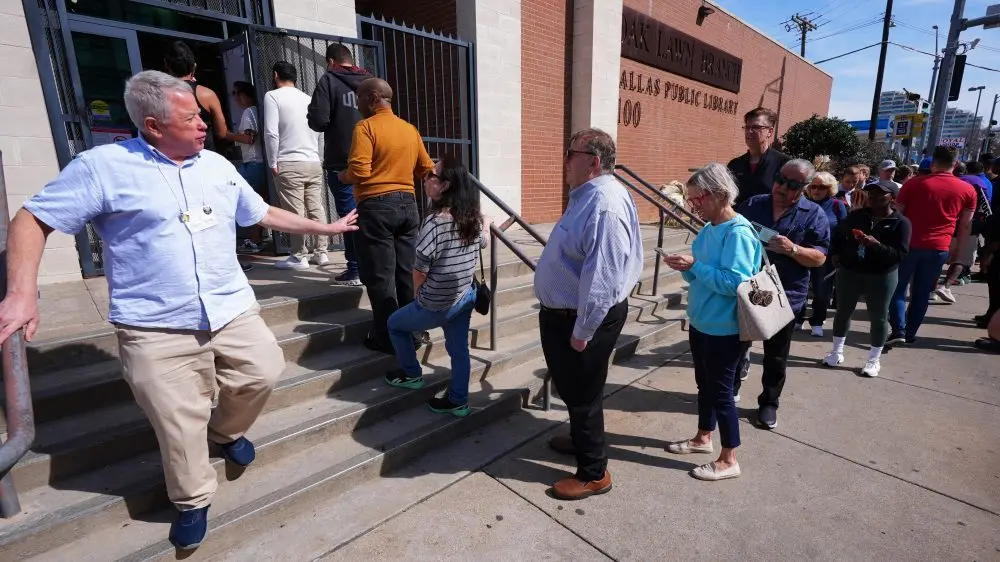
Just shy of 2 million voters participated in the 2022 Republican gubernatorial primary and nearly 1.1 million in the Democratic primary. About 53% of Republican primary votes and about 58% of Democratic primary votes were cast before primary day.
In this year’s contest, nearly 1,177,000 Democratic primary ballots and more than 1,009,000 Republican primary ballots had already been cast as of Thursday.
In the 2024 U.S. Senate primaries, the AP first reported results at 8:09 p.m. ET, or nine minutes after polls closed in most of the state. The last vote update of the night in the Democratic primary was at 4:41 a.m. ET with about 96% of total votes counted and at 5:46 a.m. ET in the Republican primary with about 98% of total votes counted.
In previous elections, counties tended to release all or nearly all results from early and absentee voting in the first vote update of the night, before any in-person Election Day results were released.
As of Tuesday, there will be 84 days until the primary runoff election, if needed, and 245 days until the 2026 midterm elections.
___
Follow the AP’s coverage of the 2026 election at https://apnews.com/hub/elections.
Brought to you by www.srnnews.com