ATLANTA (AP) — The specter of the 2020 election — when President Donald Trump refused to accept his loss to Democrat Joe Biden — continues to haunt Georgia and casts a long shadow over the Republican primary for candidates vying to be the state’s top election official.
Georgia’s current secretary of state, Brad Raffensperger, became a household name when he defended the state’s election results against Trump’s false claims about widespread voter fraud and resisted the president’s urging to help “find” enough ballots to win the race.
Now that Raffensperger is stepping down to run for governor, election oversight is a key issue in the race to replace him. Some Republican candidates are endorsing the same distortions that Trump did six years ago. The president has stocked the federal government with people who echo his conspiracy theories, and election denial has spread through state offices as well.
The race comes at a time when lawmakers have made a contradictory mess of state law governing how votes are counted. Gov. Brian Kemp on Wednesday called lawmakers into special session on June 17 for redistricting but also to address a looming deadline on voting.
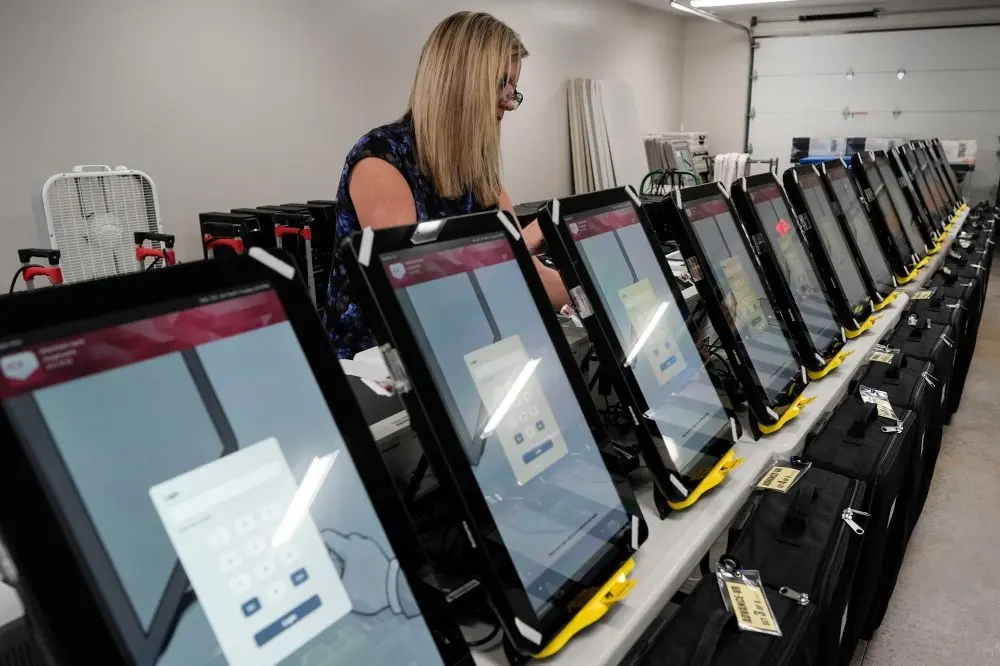
Georgia’s touch-screen voting machines print a paper ballot that includes a human-readable list of voters’ selections and a QR code that a scanner reads to count votes. Lawmakers two years ago passed a law saying QR codes could not be used for the official vote count after July 1 of this year.
However, they’ve failed to agree on an alternative method since then, causing uncertainty and the potential for lawsuits over Georgia elections until that’s sorted out.
While the special session may resolve the question temporarily, the next secretary of state will likely be involved in implementing a new voting system by 2028.
Gabriel Sterling, who was one of Raffensperger’s top aides, is the only Republican secretary of state candidate actively defending the state’s 2020 election results.
He rose to prominence by imploring Trump to help discourage threats of violence against election workers, and he said in a recent Atlanta Press Club debate that the state has “the best and safest elections in America.”
But others continue to echo Trump’s claims.
Vernon Jones, who was elected as a state representative and DeKalb County CEO as a Democrat and then switched parties to become a Republican and fervent Trump supporter, is maybe the harshest critic.
“I believe there were many irregularities. I believe violations have taken place,” Jones said, adding, “I stand with those who believe there was election fraud.”
Kelvin King, a general contractor who previously ran for U.S. Senate and is married to State Election Board member and conservative commentator Janelle King, is only a little more reserved.
“I think 2020 is still in question to be frank with you,” King said.
State Rep. Tim Fleming said he believes there were some “irregularities” in 2020 and that “great strides” have been made to address the issues. He said he’s “not running on conspiracy theories” and is focused on the future.
Fleming said he believes he and his fellow lawmakers need to find a “temporary fix” during the special session to remove the QR code from the ballot in a way that is “least disruptive for the county elections officials.” But ultimately, he said, he also wants to see the state move to hand-marked paper ballots, a position supported by many other Republicans.
Fleming previously worked for the secretary of state’s office while Brian Kemp, now the outgoing Republican governor, held the position. He led a study committee on Georgia’s election system last summer, but the committee produced only the briefest of reports.
Jones and King and Ted Metz, who has previously run for governor and secretary of state as a Libertarian, have criticized Raffensperger’s record as secretary of state. They have decried what they say is incompetence, which he denies, and a lack of transparency and are calling for a switch from touch-screen voting machines to hand-marked paper ballots. They have extended that criticism to Sterling, who oversaw the implementation of the state’s current voting system and continues to defend it.
Sterling, for his part, has insisted he is best positioned to beat a Democrat in the fall. He endlessly repeats the refrain that he has defended Georgia’s election laws and policies against attacks from “Stacey Abrams, Joe Biden’s Justice Department and the woke world.”
Cole Muzio, president of Frontline Policy, a Christian conservative group, said he believes Jones has “traction” in the closing days of the race, but said he believes that in any runoff, rank-and-file Republicans are likely to rally behind anyone who is opposing Jones. Muzio said despite Jones’ outspoken pro-MAGA position, questions about his party switch could intensify in a runoff, particularly over Jones’ switch from vociferously defending legal abortion to opposing it.
On the Democratic side, the candidates have stressed protecting the right to vote and fighting attacks on the state’s elections.
The Democrats running for secretary of state include certified financial planner and political organizer Cam Ashling; Fulton County Commissioner Dana Barrett; nonprofit founder Adrian Consonery Jr; and former Fulton County State Court Judge Penny Brown Reynolds.
Brought to you by www.srnnews.com