At the Hampton Roads Planning District Commission headquarters in Virginia, staff knew their crumbling asphalt parking lot was in desperate need of repair. But instead of replacing the lot with more dark blacktop, the group chose an alternative.
The new parking lot, completed last year, includes porous concrete panels and areas with native plants and recycled materials to make the lot cooler and less prone to flooding.
With the new panels, “the rain infiltrates faster than it can puddle and stop on the surface,” said Jill Sunderland, the commission’s senior water resources planner.
“You notice too, that it’s cooler,” Sunderland added. “You really can tell a difference out there … not to mention it’s just more inviting.”
The project is one example of how dozens of cities and other groups around the U.S. are using alternatives to traditional asphalt lots in order beat the heat and curb water runoff — especially as climate change worsens.
The City of New Orleans has required its Department of Public Works to use permeable paving in lots and other spaces where practical. In Indianapolis, the Newfields art museum transformed one parking lot to include bioretention rain gardens and another with a permeable grid instead of traditional blacktop. Denver’s dePaving a Greener Denver initiative is looking to slash the city’s cover of parking lots and other impervious surfaces.
Another way cities are cutting back on pavement is by dropping regulations that require a minimum number of parking spaces for new residential or commercial buildings. Buffalo, New York; Austin, Texas; and Minneapolis are among the cities that have changed these policies in recent years.
Asphalt industry representatives, meanwhile, are touting advances in that material while also cautioning that parking lot owners should carefully consider the durability of any non-asphalt alternative.
Here’s a look at a variety of alternatives to traditional lots.
In some downtowns, parking takes up a quarter or more of the land, and studies show that more than a third of parking spaces can sit empty at any given time, according to Adam Millard-Ball, a professor of urban planning at UCLA. Many lots see infrequent use at sporting arenas, malls or offices. So some entities offer grants for cities and businesses to replace or transform these hardscape parking areas, which have traditionally been made from asphalt.
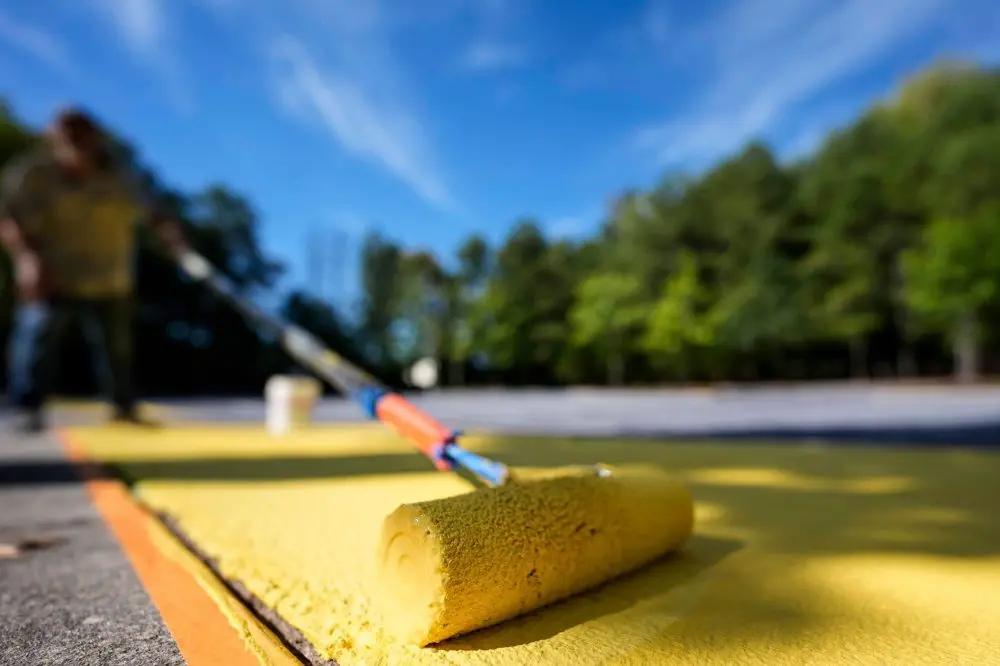
Reflective surface coatings or treatments, as used in Los Angeles’ Pacoima neighborhood, function like paint to keep the ground from absorbing as much heat.
Incorporating vegetation also helps regulate temperature by absorbing energy and releasing moisture.
Sacramento, California, requires parking lot developers to plant enough trees to shade half the lot within 15 years of its construction. Washington, D.C., and Seattle have green area requirements for landscaping, particularly for new development. Some cities leverage solar panel installations as shade structures.
Without these fixes, dark paved surfaces can trap heat and drive temperatures up by as much as 20 degrees. That heat typically builds up during the day.
The heat spreads, contributing to what’s known as the urban heat island effect, said Vincent Cotrone, extension educator of urban forestry at Pennsylvania State University. Warmer neighborhoods often lead to high energy use, as people rely more on air conditioning to stay cool. Those AC units push hot air back outside.
Other alternatives aim to solve problems that occur when impervious pavement prevents rainwater from soaking into the ground. When water runs off paved surfaces, it can carry pollutants like oil and heavy metals into nearby waterways, said Cotrone.
More advanced than gravel, lattice pavers allow for grass to grow. These, as well as interlocking pavers that create spaces between individual units, allow for rainwater to filter through. Other permeable substances used for runoff control include stone beds, brick pavers or honeycomb-style structures.
The Hampton Roads Planning District Commission uses a stamped, grooved concrete border, so that when stormwater runoff flows from traditional concrete to the porous concrete, sediment gets trapped instead of clogging up and needing maintenance.
Long channels of plants known as bioswales and recessed sections known as rain gardens both use sand, soil and plants to filter pollutants before stormwater reaches streams or sewers.
At the Newfields museum in Indianapolis, one parking lot features rain gardens, while the overflow parking lot is made of recycled plastic grid pavers.
“It has worked really well for us because we don’t park on that lot every single day,” said Jonathan Wright, director of the garden. “Why should it be asphalt and not breathing and not permeable when you only need to use it 10% of the time?”
Alternative materials may cost more up front, so experts said that it’s important for owners to do a cost analysis that factors in other benefits over a parking lot lifetime.
“If we were going to just repave it with asphalt, we could have done it significantly cheaper,” said Sunderland, of the Virginia project. “It’s more expensive initially, but you get so much more life out of it.”
Buzz Powell, technical director at the Asphalt Pavement Alliance, a coalition of national industry groups, said asphalt is more versatile and designed to handle heavy traffic better than some of the newer alternatives, and that any new pavement may need repairs eventually.
“I just think we need to be really, really careful when we put alternative systems in to make sure that we have a good understanding of what the life cycle impact is gonna be,” Powell said. “Some things can be really sexy on the front end and look good on paper, but then when you run a trash truck over it, it can’t handle the stresses and strains.”
Asphalt can be installed at different thicknesses for different needs, and porous asphalt is becoming more popular. He said it may repair more easily — and all options are going to have tradeoffs as far as environmental impact, longevity and maintenance, depending on use.
“My focus is 100% to make asphalt better,” he added. “If we do better asphalt, that means better mixing materials, better structural pavement design, and better pavement preservation.”
Some experts who favor alternatives also worry that budget-constrained cities interested in redoing parking lots won’t be able to find the funding.
“We are headed in the right direction, but at the same time, we’ve got acres and acres of nothing but blacktop parking lots that sit there and age and again, heat up,” said Cotrone. “And we just don’t have the dollars to go retrofit those.”
But ultimately, improving how parking lots are built, or reducing how much space they take up altogether, can help address multiple challenges at once, from heat to water quality to related inequality issues.
“The reality is, one city changing their surfaces is just not by itself not going to have a big impact,” said Greg Kats, founder of the Smart Surfaces Coalition. “But once cities are able to understand in a rigorous way the scale of the benefits… it’s kind of intuitive.”
___
Read more of AP’s climate coverage.
___
The Associated Press’ climate and environmental coverage receives financial support from multiple private foundations. AP is solely responsible for all content. Find AP’s standards for working with philanthropies, a list of supporters and funded coverage areas at AP.org.
Brought to you by www.srnnews.com