Investigators have uncovered numerous factors that contributed to an Army helicopter and a passenger airplane colliding over Washington, D.C., last January, killing 67 people in the deadliest U.S. air disaster since 2001.
The National Transportation Safety Board will discuss the investigation’s findings Tuesday and recommend changes to prevent similar tragedies. Thursday marks one year since the crash.
The NTSB has said the helicopter was flying higher than it was supposed to and the altimeter the pilots relied on was faulty. Plus, the Federal Aviation Administration failed to act on warnings about the risks around Washington that the NTSB said should have been clear years earlier.
The FAA is making temporary changes it imposed after the crash permanent. The rules say helicopters and planes can’t share the same airspace around Reagan National Airport, and they prohibit air traffic controllers from relying on visual separation and require all military aircraft to broadcast their locations.
Here’s a timeline of events related to the crash:
Around 8:15 p.m., American Airlines Flight 5342, with 64 people on board, begins its initial descent into Reagan National Airport.
At 8:43, from the airport’s tower, a controller asks the plane’s pilots to switch from landing on Runway 1 to Runway 33. Nearby an Army Black Hawk helicopter, referred to as PAT25 by air traffic control, is flying south over the river. The skies are clear.
As the helicopter approaches the airport, the cockpit voice recorder captures the pilot saying it is flying at 300 feet (91 meters) and the instructor pilot says it is at 400 feet (122 meters). The discrepancy isn’t explained and the helicopter continues to descend. The helicopter route’s allowed altitude decreases the closer it gets to the airport, capping at 200 feet (61 meters).
At 8:46, the controller radios the Black Hawk crew to say a passenger jet, referred to as CRJ, is at 1,200 feet (365 meters) and circling to Runway 33. The helicopter’s pilots say they see the jet and ask to maintain visual separation — to fly closer than if the pilots didn’t see the plane. Controllers approve the request.
At 8:47 — 20 seconds before impact — the controller radios: “PAT25, do you have the CRJ in sight?” while a conflict alarm sounds. Then, again: “PAT25, pass behind the CRJ.” But the NTSB said the helicopter’s recorder shows the pilots may never have heard that instruction.
One second later the plane’s crew gets a collision avoidance alert declaring “Traffic! Traffic!”
A few seconds later, a crew member on the helicopter replies that the aircraft “is in sight” and again requests “visual separation.”
Just after the plane descends past its last recorded altitude of 313 feet (95 meters), the pilots pull up the nose sharply in an evasive maneuver one second before impact.
Then a commotion is heard on the tower audio. A flash appears in the sky, and both aircraft fall into the river. Moments later someone says over the radio, “Tower, did you see that?”
In the ensuing hours and days, crews search the chilly Potomac for survivors.
In the morning, Trump tells reporters there are no survivors. By midday the bodies of all three soldiers in the helicopter have been recovered.
About 2 miles (3.2 kilometers) downriver, Dean Naujoks, who patrols the Potomac for the Waterkeeper Alliance, finds pages from the flight manual, a piece of the plane’s cabin wall and dozens of sugar packets stamped with the American Airlines logo.
In the evening, the airplane’s cockpit voice and flight data recorders are sent to the NTSB lab.
Officials announce that the Black Hawk’s black box has been recovered and the flight data is being reviewed, along with the actions of the military pilot and air traffic control.
By the afternoon, the remains of 41 people have been recovered.
The Army names two of the dead soldiers: Staff Sgt. Ryan Austin O’Hara, 28, of Lilburn, Georgia, the crew chief; and Chief Warrant Officer 2 Andrew Loyd Eaves, 39, of Great Mills, Maryland.
Investigators say they are trying to work out a discrepancy in the altitude data between the helicopter and the airliner. They hope the helicopter’s black box can help reconcile the difference. The box is waterlogged, delaying data retrieval.
The Army identifies the third soldier: Capt. Rebecca M. Lobach. She is described by friends as “brilliant and fearless.”
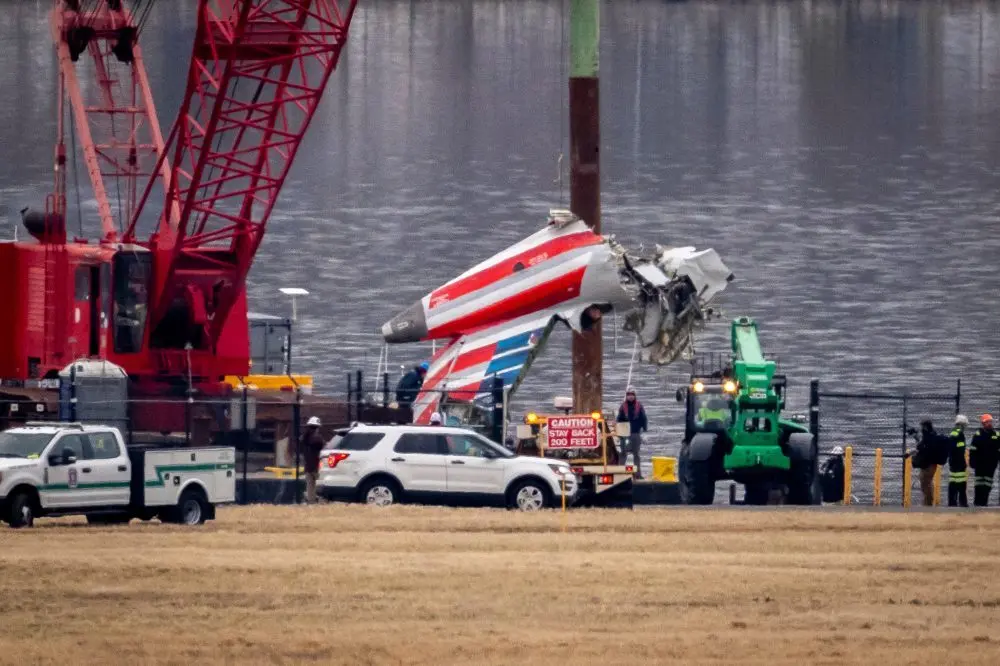
Officials say the remains of 55 victims have been recovered. Salvage crews prepare to lift wreckage from the Potomac.
Crews recover parts of the airliner as families gather along the Potomac.
Crews working in choppy conditions raise a number of large pieces of the jetliner.
Authorities say the remains of all 67 victims of the collision have been recovered.
Memorials for the victims begin. A flight attendant is remembered in North Carolina as a loving family member who loved his career.
Crews finish removing major components of the helicopter and jet from the river. NTSB investigators examine the wreckage at a secure hangar.
Texas Republican Sen. Ted Cruz says NTSB officials told senators that the helicopter’s ADS-B system — the Automatic Dependent Surveillance-Broadcast that transmits location and other data to traffic controllers and other aircraft — was off.
The NTSB offers another update that raises doubts about whether the helicopter pilots had accurate information on their altitude.
Investigators finish their work at the crash, but continue interviewing, testing and examining the wreckage of both aircraft.
Some of figure skating’s biggest stars raise $1.2 million in Washington for the victims’ families. The victims included 28 members of the figure skating community, some of whom lived and trained in the Washington area. They died coming home from a camp for elite junior skaters that followed the U.S. Figure Skating Championships in Wichita, Kansas’ largest city.
Federal investigators recommend banning some helicopter flights near Reagan National Airport, saying the setup “poses an intolerable risk.” U.S. Transportation Secretary Sean Duffy adopted those recommendations.
Helicopters no longer will be “threading the needle” flying under landing planes, Duffy said.
The FAA also will use artificial intelligence to analyze airport data for similar dangers elsewhere. Duffy said the FAA should have recognized the hazards at Reagan airport earlier.
The acting head of the FAA told Congress that the agency has to do a better job of addressing safety risks.
The head of the NTSB and Congress members again questioned how the FAA hadn’t addressed an alarming number of close calls near Reagan Airport before the crash.
“We have to identify trends, we have to get smarter about how we use data, and when we put corrective actions in place, we must execute them,” said Chris Rocheleau, the agency’s acting administrator at the time.
A federal review prompted by the Washington collision reveals dangerous flying conditions at the Las Vegas airport and leads the FAA to impose new restrictions on helicopter flights around Harry Reid International Airport.
The agency says the changes cut the number of collision alerts in Las Vegas by 30%. Rocheleau promised to take additional actions in Las Vegas and at any other airport where the FAA identifies concerns.
The Army pauses helicopter flights near Reagan after two commercial planes aborted landings because of an Army Black Hawk helicopter flying to the Pentagon.
The 12th Aviation Battalion pauses helicopter flights near the airport.
The unit had just begun a return to flight, with plans to gradually increase.
Two different airline jets were instructed by air traffic control to “perform go-arounds” because of a “priority air transport” helicopter.
Duffy announces a plan to overhaul the aging system that air traffic controllers use. Parts still rely on floppy disks and are no longer made by the manufacturer.
The plan calls for six new air traffic control centers, along with technology and communications upgrades at U.S. air traffic facilities before 2029. Congress approved $12.5 billion as a down payment. Duffy has said that another $20 billion will be needed.
The FAA has already committed more than $6 billion to the project. The agency upgraded some of the system to more modern connections. Peraton will oversee the rest of the overhaul.
The NTSB questioned FAA, Army and airline officials over three days.
The hearings highlighted the fact that the helicopter’s altimeter was faulty, and the pilots’ night vision goggles made spotting the plane harder.
It also became clear that controllers warned the FAA years earlier about the dangers of helicopters in the crowded airspace around the nation’s capitol, but changes weren’t made.
NTSB Chairwoman Jennifer Homendy scolded the FAA.
“Are you kidding me? Sixty-seven people are dead! How do you explain that? Our bureaucratic process?” she said. “Fix it. Do better.”
Brought to you by www.srnnews.com