NEW YORK (AP) — Tom McGee began climbing stairs for exercise 20 years ago as part of an effort to stay off cigarettes. It hasn’t always been easy: His climbs in hotel stairwells sometimes draw the attention of security guards.
“I’ve gotten kicked out of about every hotel in the city,” said McGee, a 69-year-old market researcher who lives near Chicago.
Climbing stairs has become increasingly ingrained in exercise guidance, but many people who do it regularly say it can be challenging in an era where office tower managers commonly cut off access to stairwells.
Here’s a look at stair climbing as a form of exercise, and some of the unexpected challenges some people face in trying to do it.
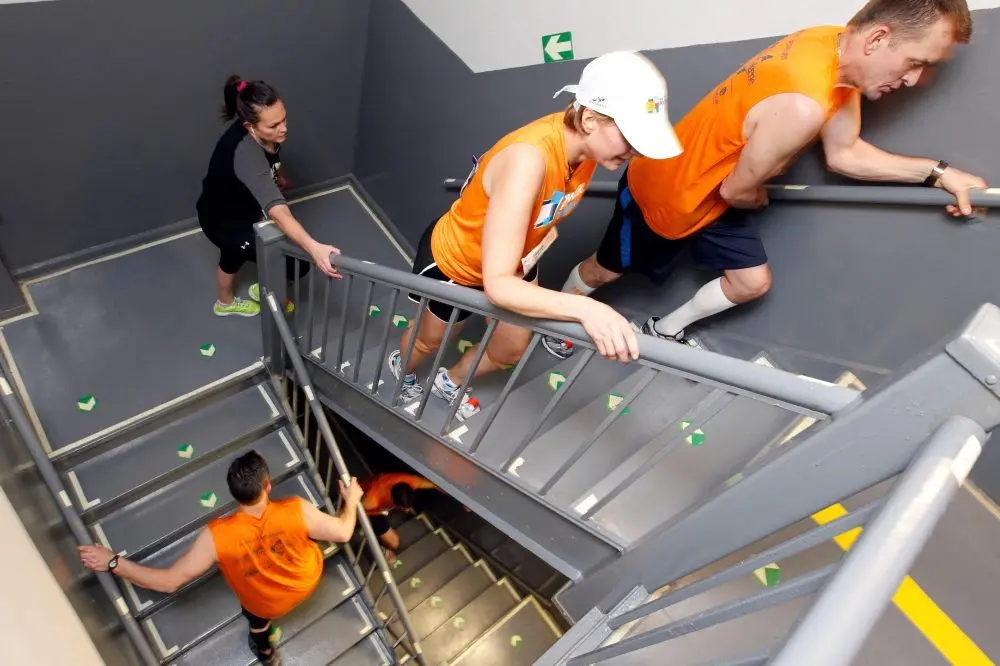
Dr. Luis Rodriguez, a semi-retired pediatric pulmonologist, participates in stair-climbing events and lauds the benefits.
“You are working your legs. You are working your heart. You are working your lungs,” said Rodriguez, 66. “You can get a lot more benefit than just walking, because gravity is working against you.”
He’s backed up by research that found climbing stairs for four minutes is roughly equivalent to about 10 minutes of brisk walking or 20 minutes of slower walking.
In 2018, federal physical activity guidance was changed to promote short-burst activities — like taking the stairs every time you have to move between floors at work. The guidelines said such activities can add up over the course of a day, meaning you can improve your health even if you can’t go for a run or do a 30-minute workout.
Many people “don’t realize that they don’t have to exercise all in one bout for it to be effective,” said Stella Volpe, a Virginia Tech exercise expert.
Stair climbing also has the potential to improve mental health for many people and is associated with improved feelings of energy, said Jennifer Gay, a public health researcher at the University of Georgia.
People who might have trouble on stairs should talk to their doctors before trying a climbing regimen, experts say.
The American Lung Association holds fundraising events each spring in office towers in cities across the country. The “Fight for Air” events are widely regarded as fun, but organizers say the name draws from the shortness of breath people can experience after climbing dozens of floors — or having a lung disease.
Landlords aren’t always so accommodating.
Some law firms tell landlords and building owners that they can he held liable if someone trips or slips on a staircase. Poor lighting, liquid on steps and broken handrails are among the conditions that can be cited in lawsuits if someone falls and gets hurt.
Many building managers have taken such advice to heart, saying stairs can only be used in emergencies.
A study of hospital emergency department visits, published in 2018, concluded that more than 1 million stair-related injuries occur in the U.S. each year, with broken bones more common in older people. More than 60% of the injured were women.
Research suggests there’s very little risk of injuries for people climbing stairs, Gay said. Going down stairs can be riskier and building managers “can’t make it a one-way street,” she added.
For more than a decade, some health advocates have pressed for better access to steps.
In 2013, a California-based health policy nonprofit called ChangeLab Solutions issued a resource guide that urged property owners to open their stairwells, arguing they posed no greater liability risk than other common areas.
Gay and her colleagues have estimated that 60% of U.S. workers do their jobs in multistory buildings with stairwells. But there are no statistics showing what percentage of those buildings have restrictions on stair access.
Many people who like to climb have stories about trouble finding staircases they can use.
Lisa Bai, a New Yorker who works in real estate, said she’s not able to use the stairs in her office building. It would seem like an easy way to get some exercise, but sometimes “it’s not,” she said.
Bai and others say they find other ways to step up. Fitness equipment such as StairMaster machines can approximate the physical work of stair climbing, although people who participate in tower climbs say it isn’t as arduous as the real thing.
You might have to get creative if you don’t have easy access to stairs at home or in public spaces.
Carmen Erickson and Vivian Dawson, who live in the Detroit suburbs, have been meeting about three times a week to climb stairs, usually in a nearby park, for roughly a decade.
But it can be trickier when they travel. When they vacation together, they make a point to stay on the top floor of tall hotels so they can use the stairs. They also look for hills and hospital parking decks.
They also have negotiated after-hours access to one building’s stairwells, agreeing to sign a waiver and check in with security officers each time.
“If you connect with the right people and tell them what they’re doing and agree to the rules, it hasn’t really been a problem for us,” said Erickson, 53.
But Dawson, 64, added: “You have to really want to do it.”
___
The Associated Press Health and Science Department receives support from the Howard Hughes Medical Institute’s Department of Science Education and the Robert Wood Johnson Foundation. The AP is solely responsible for all content.
Brought to you by www.srnnews.com