JEFFERSON CITY, Mo. (AP) — New U.S. House districts in Missouri backed by President Donald Trump can be used ahead of the midterm elections, despite the potential for a voter referendum on the new map, a judge ruled Friday.
The decision by Cole County Circuit Judge Brian Stumpe marked a triumph for Republicans, who hope the districts will help them win an additional congressional seat in the November midterm elections.
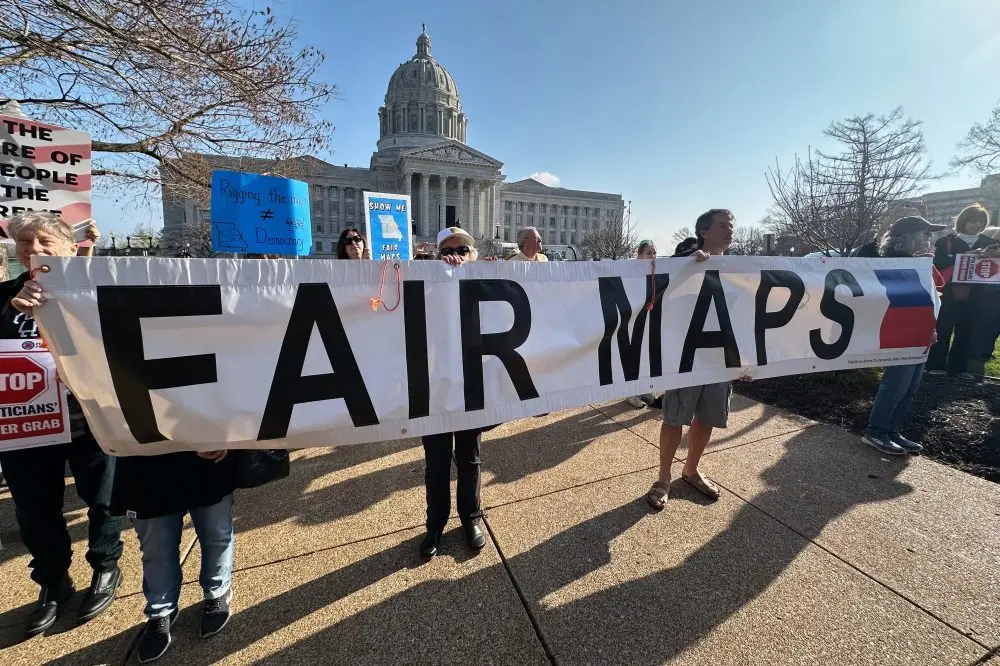
Opponents of the new districts asserted they should have been automatically suspended in December when more than 300,000 petition signatures were submitted calling for a statewide referendum on the plan.
But Stumpe said opponents lacked the legal grounds to sue, had done so too soon and were asking the court to get involved in a political question best left to the executive and legislative branches. He said the new map can be suspended only if it is ultimately determined that the referendum petition meets legal muster and contains enough valid signatures.
“Without verification requirements, any group could suspend legislation merely by submitting boxes of invalid signatures, signatures of unregistered voters, forged names, or other fraudulent submissions,” Stumpe wrote. “Clearly, the framers of Missouri’s Constitution could not have intended such an easily exploited system that would allow bad-faith actors to paralyze the legislative process.”
Under state law, Republican Secretary of State Denny Hoskins has until Aug. 4 — the date of Missouri’s primary election — to make a final determination on the validity of the referendum petition.
Missouri is one of several states engaged in a national redistricting battle that began last summer when Trump called upon Texas Republicans to redraw House districts to try to give the GOP an advantage in this year’s midterm elections. After Texas acted, California Democrats reciprocated with their own new districts, and a tit-for-tat redistricting clash soon spread among states.
The redistricting fight, so far, has resulted in only a slight edge for Republicans as they try to hold on to their narrow House majority. But voters in Virginia are deciding in an April 21 election whether to authorize a mid-decade redistricting that could help Democrats win several additional seats.
It’s uncertain whether all the manipulation of voting district boundaries ultimately will make a difference in which party wins control of the House. The party in power typically loses seats in the midterms and Trump faces negative approval ratings in polls.
Missouri currently is represented in the U.S. House by six Republicans and two Democrats under a map passed in 2022 based on the most recent census. At the time, Republican lawmakers turned back an attempt by some in the party to push a map giving Republicans a shot at winning seven seats. They cited concerns that it could spread Republicans too thin and backfire in losses if Democrats enjoyed a favorable election year.
But Republicans set aside those concerns last year under pressure from the White House to revise the districts for partisan advantage.
A new map passed during a September special legislative session was intended to help Republicans win a Kansas City-area seat currently held by Democratic U.S. Rep. Emanuel Cleaver. It reassigned portions of Kansas City to two neighboring districts represented by Republicans and stretched the remainder of his 5th Congressional District eastward into Republican-heavy rural areas.
The Missouri Supreme Court on Tuesday rejected a legal challenge asserting that mid-decade redistricting wasn’t allowed under the state constitution. A trial court also recently rejected a legal challenge asserting that the new districts violate constitutional requirements to be compact. Plaintiffs have appealed that case to the state Supreme Court.
Brought to you by www.srnnews.com