UNITED NATIONS (AP) — President Donald Trump’s ambition for the “Board of Peace” to play a role in global conflicts beyond Gaza appears to be the latest U.S. attempt to sidestep the U.N. Security Council, raising new questions about the relevance of the 80-year-old world body and uncertainty about its future as a primary force in brokering peace worldwide.
Trump is establishing the board, to be composed largely of invited heads of state, as the U.N. has embarked on major reforms intended to modernize an organization founded on the ashes of World War II and make it a more viable global player in the 21st century.
A decades-long reform effort gained new impetus after the Trump administration last year set out to eliminate billions of dollars in funding to international organizations and humanitarian assistance at large.
Cutting life-saving humanitarian efforts, consolidating major agencies and moving personnel out of New York headquarters are just a few of the changes the U.N. has made as it courts continued support from the U.S., traditionally its largest donor.
Trump and his allies have blasted the organization for not reaching its full potential and accused it of having “bloated” and redundant agencies that push “woke” ideology. The U.S. refused to pay its mandatory dues to the U.N. last year.
The Security Council — the U.N.’s most powerful body with the clout to authorize military action — has failed in recent years to end wars, including in Gaza and Ukraine. It’s a point Trump has hit on since the beginning of his second term and he did so again several times this week.
“The U.N. just hasn’t been very helpful. I’m a big fan of the U.N.’s potential, but it has never lived up to its potential,” Trump told reporters during a White House press briefing. “The U.N. should have settled every one of the wars that I settled. I never went to them. I never even thought to go to them.”
Despite his complaints, he added that “I believe you got to let the U.N. continue, because the potential is so great.”
The Security Council in November authorized the Board of Peace to serve as a transitional body to oversee a U.S.-brokered ceasefire in the Israel-Hamas war in Gaza, as Trump proposed. But in forming the board, he has described its role as a mediator for other global conflicts, a potential rival to the U.N. Security Council.
Retired U.S. Ambassador Robert Wood, who served at the U.S. Mission to the United Nations under Republican and Democratic leaders, said if Trump is trying to replace the Security Council with a Board of Peace dealing with issues beyond Gaza, “I don’t think there’s going to be a lot of interest.”
“What I would say to U.N. member states, including the United States: Let’s try to work together to try to make the United Nations a better instrument. It really is the best instrument we have, given all its warts,” Wood told The Associated Press. “But trying to recreate something new in this type of era, with all the divisions that exist and the fact that most of the developing world puts a lot of emphasis on the United Nations and the conflict resolution mechanism, I just don’t see how this would work.”
U.N. officials on Wednesday dismissed concerns, saying it is unlikely that decades of multilateral peacebuilding with the participation of more than 190 member countries could be replaced.
“There have been any number of organizations — regional organizations, defense alliances and others — that have coexisted with the U.N. over the 80 years that the U.N.’s been in existence,” Farhan Haq, U.N. deputy spokesperson, said Wednesday.
He added, “It’s too early to tell what the Board of Peace will look like.”
It was not immediately clear how many countries would accept Trump’s invitation to join the board.
Eight Muslim countries — including Qatar, Pakistan and the United Arab Emirates — accepted the invitation on Wednesday but reaffirmed their commitment in a joint statement to support the board’s original mission aimed at advancing peace and reconstruction in Gaza and the Palestinians’ right to statehood.
France, a veto-wielding member of the Security Council, has said it will not accept Trump’s invitation, while the three other members with vetoes — Russia, China and Britain — are still assessing it.
As of Wednesday, Norway, Sweden and Slovenia had also declined. Slovenia’s main concern was that the board’s mandate is too broad and it could seriously undermine the international order based on the U.N. Charter.
One European diplomat told The Associated Press that EU countries “feels a bit awkward” about the effort and would prefer that there be discussions on the Board of Peace plan regarding Gaza before engaging on this broader initiative.
In a stark speech in Davos on Tuesday, Canadian Prime Minister Mark Carney warned that the rules-based order is fading.
“The multilateral institutions on which the middle powers have relied … the very architecture of collective problem solving, are under threat,” he said, singling out the United Nations among others. “And as a result, many countries are drawing the same conclusions — that they must develop greater strategic autonomy, in energy, food, critical minerals, in finance and supply chains.”
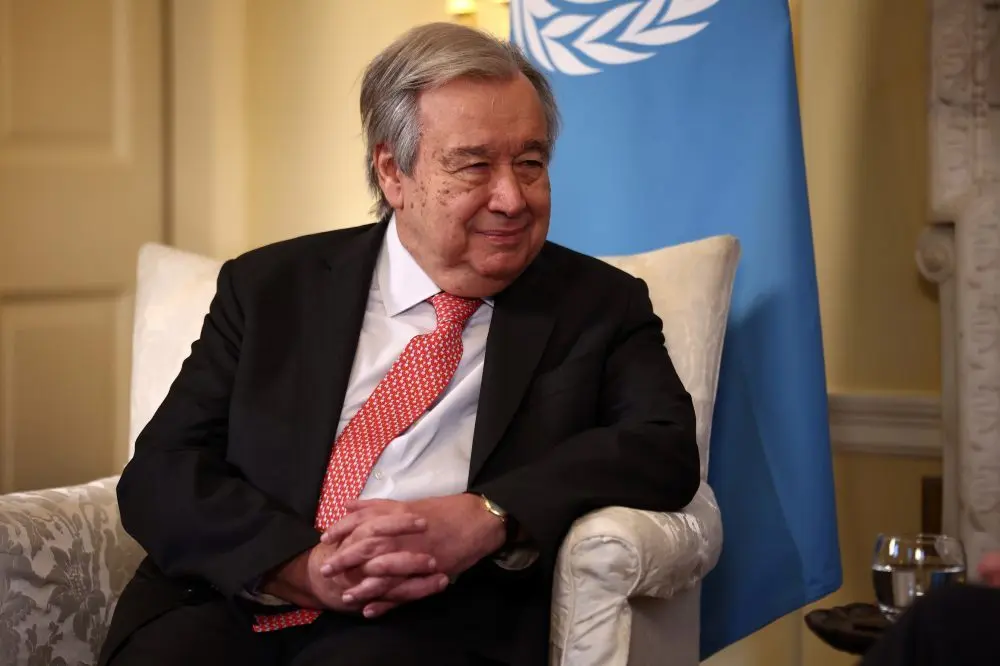
Guterres, asked by the BBC on Monday if the United Nations can survive the Trump presidency, replied: “I have no doubt about it.”
“I have a lot of confidence in the future of humankind, and I’m fighting as much as I can in order to make sure the U.N. is part of that renewal that I believe will become inevitable,” he said.
Brought to you by www.srnnews.com