
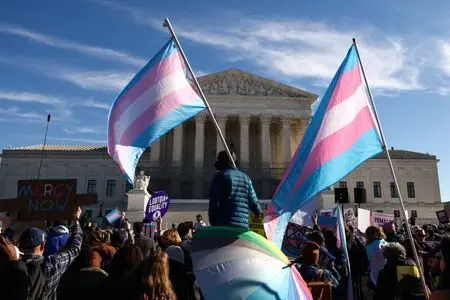
By Andrew Chung
March 2 (Reuters) – The U.S. Supreme Court blocked on Monday a series of California laws that can limit the sharing of information with parents about the gender identity of transgender public school students without the child’s permission, handing a victory to Christian parents who challenged these protections.
The justices granted an emergency request by the challengers to reinstate a judge’s ruling that the privacy and anti-discrimination measures at issue undermined their religious and parental rights under the U.S. Constitution’s First and 14th Amendments, while litigation continues. A federal appeals court had put that ruling on hold.
The Supreme Court’s three liberal justices dissented from Monday’s decision.
The California lawsuit is one of many disputes concerning efforts to protect the privacy of transgender and gender-nonconforming students playing out across the United States.
The Supreme Court is also considering whether to take up a lawsuit against a Massachusetts public school district over actions by teachers and officials to support the gender identity of students. The court in 2024 turned away similar challenges in Wisconsin and Maryland.
The Supreme Court, which has a 6-3 conservative majority, has been asked repeatedly to rule on efforts by President Donald Trump’s administration and Republican-led states to restrict the rights of transgender people.
The Supreme Court last year upheld Tennessee’s ban on gender-affirming medical care for transgender minors and also let Trump ban transgender people from the military. It heard arguments on January 13 concerning state laws in Idaho and West Virginia banning transgender athletes from female sports teams, with the conservative justices appearing ready to uphold those restrictions.
California law contains several provisions, including the right to privacy under the state constitution, that the state has said could apply when transgender students object to having their gender identities disclosed to their parents or guardians, sometimes out of fear of hostility, rejection or even violence.
The challengers in a 2023 lawsuit challenging the constitutionality of the provisions said the measures require public schools to facilitate “secret gender transition” and to “hide children’s expressed transgender status at school from their own parents – including religious parents.”
The Democratic-governed state has said the provisions do not actually forbid sharing information with parents, and sometimes even allow or require disclosure if not doing so would endanger the student’s health.
The lawsuit was brought by Christian teachers from the Escondido Union School District in San Diego County, who argued that complying with the measures violated their First Amendment rights to freedom of speech and free exercise of religion.
Two devoutly Catholic married couples also sued, alleging that their children expressed themselves as transgender boys at school without the knowledge or consent of their parents, violating their religious rights and their right as parents under the 14th Amendment’s due process provision to direct the care of their children.
U.S. District Judge Roger Benitez in December ruled in favor of the plaintiffs and issued an order blocking these measures.
“A child’s gender incongruity is a matter of health. Matters of a child’s health are matters over which parents have the highest right and duty of care,” Benitez wrote in the ruling.
Benitez blocked the state laws that would prevent school employees from informing parents “about their child’s gender presentation at school” or allow the use of names or pronouns that do not “match the child’s legal name and natal pronouns” without parental consent.
The San Francisco-based 9th U.S. Circuit Court of Appeals put Benitez’s ruling on hold on January 5, citing multiple errors in the judge’s analysis.
“A preliminary review of the record shows that the state does not categorically forbid disclosure of information about students’ gender identities to parents without student consent,” the 9th Circuit’s ruling stated.
(Reporting by Andrew Chung)
Brought to you by www.srnnews.com