President Trump’s China Visit Produces Trade Signals but No Strategic Breakthrough
By The Media Line Staff
US President Donald Trump’s state visit to China has produced a carefully managed diplomatic thaw, with Washington and Beijing announcing plans for closer trade and investment coordination, possible major Chinese purchases of Boeing aircraft, and a White House invitation for Chinese President Xi Jinping, while leaving deeper disputes over Taiwan, tariffs, advanced technology, rare earths, and Iran unresolved.
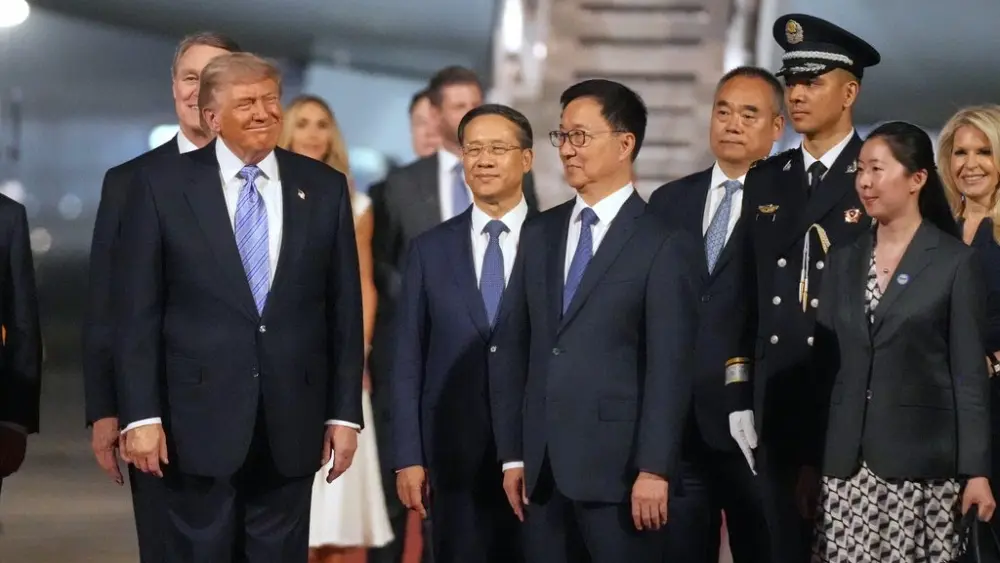
President Trump and Xi met on Thursday at the Great Hall of the People in Beijing during the American president’s first visit to China since 2017. The talks followed President Trump’s arrival in Beijing on Wednesday and came as both governments sought to stabilize relations after months of trade tensions and strategic rivalry.
Chinese officials framed the meeting as an effort to build a more stable relationship over the next several years. Xi told President Trump that China and the US should be “partners, rather than rivals,” according to public readouts of the meeting. At the same time, the Chinese president warned Washington to handle Taiwan with “utmost caution,” saying the issue could lead to an “extremely dangerous situation” if mishandled.
Taiwan remains the most sensitive political dispute between the two governments. Beijing claims the self-ruled island as part of China and has not ruled out using force to bring it under its control. Taiwan’s government rejects China’s claim and says only the island’s people can decide their future. Washington maintains unofficial relations with Taipei and supplies Taiwan with weapons, while formally recognizing Beijing as China’s government.
The economic portion of the visit appeared to produce the clearest movement. Treasury Secretary Scott Bessent said he expected a large Chinese order for Boeing aircraft to be announced during the trip. He also said the two sides were discussing Chinese purchases of US energy and agricultural products, as well as potential Chinese investment in non-sensitive sectors of the American economy.
Bessent said Washington and Beijing were weighing the creation of a bilateral “Board of Trade” and “Board of Investment” to organize future economic engagement. He also pushed back on reports that the administration was seeking $1 trillion in Chinese investment, saying that figure was not the basis of the discussions.
Technology remained one of the most closely watched issues. The US has reportedly approved sales of Nvidia H200 artificial intelligence chips to several major Chinese companies, including Alibaba, Tencent, ByteDance, and JD.com, though deliveries have not yet begun. Nvidia Chief Executive Jensen Huang joined President Trump’s delegation in Beijing, reflecting the central place of semiconductors and artificial intelligence in the relationship.
For Washington, chip exports raise questions about revenue, technological leadership, and national security. For Beijing, the issue is tied to China’s effort to reduce dependence on US technology while maintaining access to high-end hardware needed for artificial intelligence development.
The visit also carried a strong business message. Senior executives from major American companies, including Nvidia, Tesla, and Apple, were present in Beijing as Xi sought to reassure foreign investors that China remained open for business. The message comes at a time when foreign companies are weighing opportunities in the Chinese market against regulatory risk, weak domestic demand, and rising geopolitical pressure.
President Trump also invited Xi and his wife, Peng Liyuan, to visit the White House on Sept. 24. Officials have suggested the two leaders may meet several times this year, including at the Group of 20 summit in Miami and the Asia-Pacific Economic Cooperation meeting in Guangzhou.
The war involving Iran also figured in the talks. Public reporting so far points to diplomatic positioning rather than a major Chinese commitment. The two sides discussed the Middle East conflict, energy flows through the Strait of Hormuz, China’s role in global oil markets, and US concerns about sanctions enforcement. China remains a major buyer of Iranian oil, while the US wants Beijing to avoid undercutting pressure on Tehran.
Ceremonially, the trip appears to have gone smoothly, with a formal welcome, a visit to the Temple of Heaven, a state banquet, and top-level meetings designed to show stability. Substantively, the visit looks less like a breakthrough than a pause in a long-running contest. Both governments gained useful optics and possible commercial deals, but the main disputes remain unsettled.
President Trump is expected to leave China on Friday, May 15.
Brought to you by www.srnnews.com